


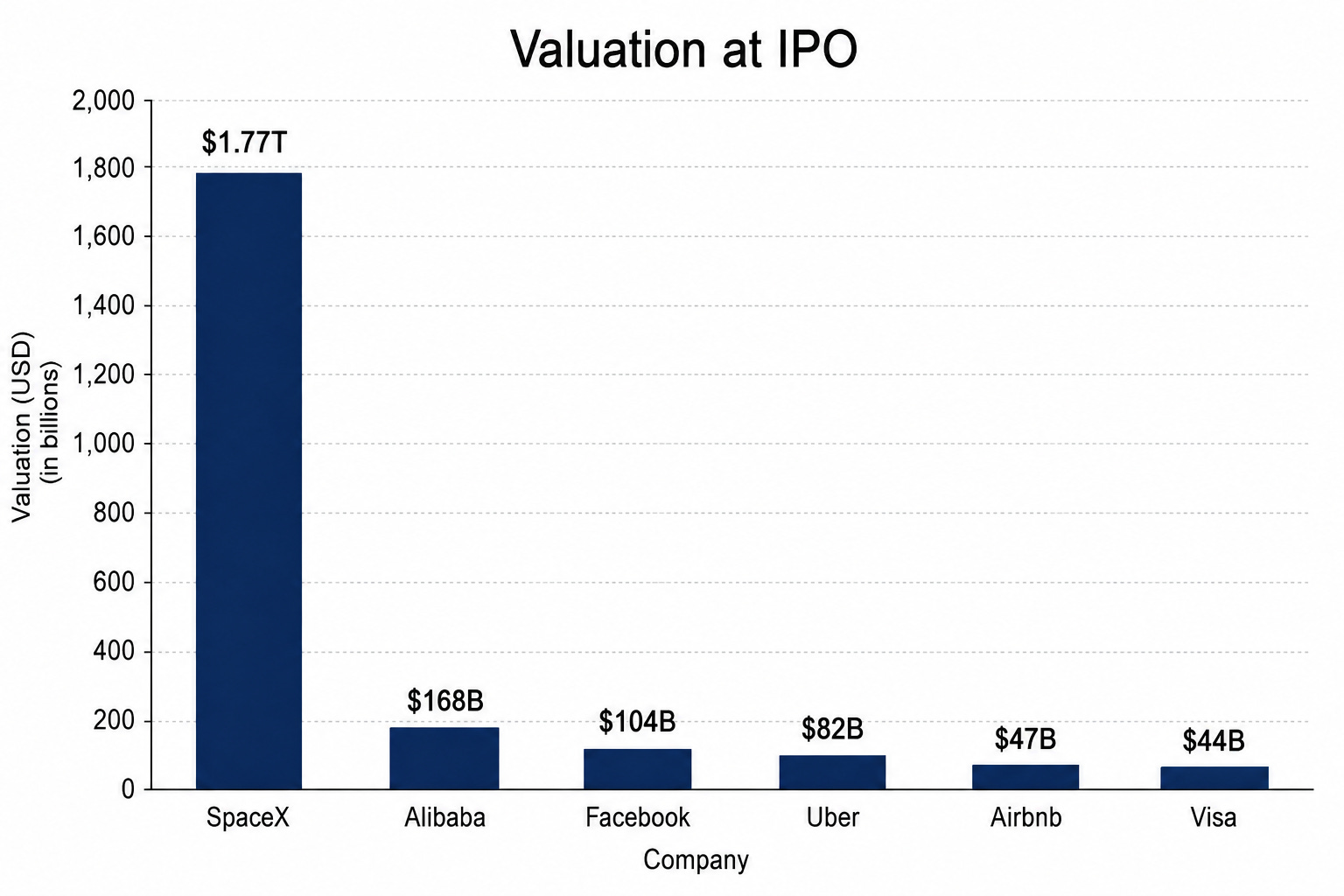
The summer of 2026 will be remembered for two milestones. The first belonged to the markets. In early June, SpaceX went public at a valuation of $1.77 trillion—the largest IPO in history. For twenty years, we’ve watched companies such as Visa, Facebook (Meta), Alibaba, Uber, and Airbnb make their public debuts. Small ball in comparison.
It could be the climate of the times, or maybe a lightning rod named Elon, but no other IPO generated as much emotional energy as SpaceX.
Should we buy it? Can we get in on the IPO price before it pops? Will the funds in our portfolio own it?
Reasonable questions. Who isn’t drawn toward the prospect of a quick buck? Or fearful of missing out on something big, especially if a neighbor claims to be in?
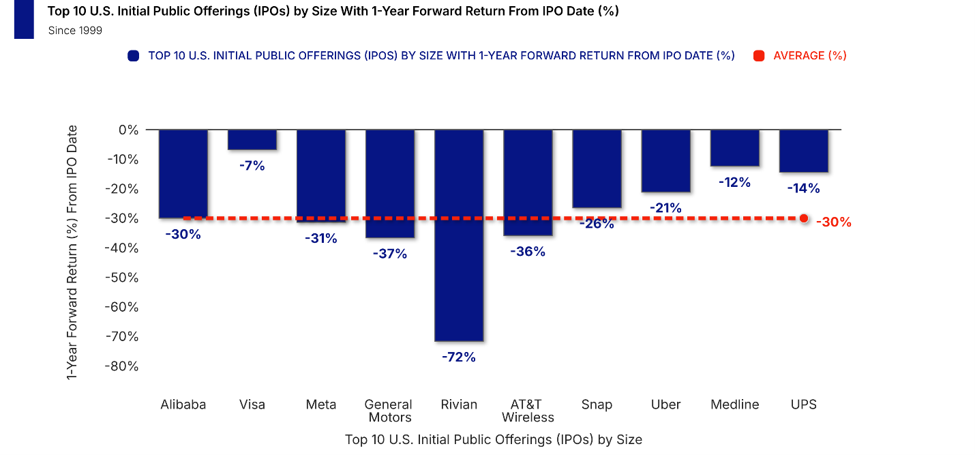
“No,” we answered, offering a reminder that historically IPOs have been rotten investments out of the gate.
From there, the other questions largely answered themselves. Why jump right in? And why would fund managers act differently?
IPOs suck oxygen out of the investment room. They’re mostly a distraction from achieving goals. SpaceX offered only 5% of its shares to the public, and for all the fanfare, it represented just 0.14% of the U.S. total stock market and 0.08% of the world stock market. Even a spectacular move higher would barely register in a diversified portfolio.
For those not following along, SpaceX opened at $150, catapulted to $225, plunged to $100, and closed yesterday around $135, below where it opened.
As summer moved along and equity markets notched their 27th new all-time high, worries turned from the prospect of making a buck to losing ones already earned. If SpaceX had sucked oxygen out of the room, AI didn’t give it back.
Should we reduce our exposure to AI? Hasn’t the market become way too expensive? Isn’t this another dot-com?
And of course, the timeless biggie… Are we in a bubble?
While AI is the catalyst this time, our answer hasn’t ever changed.
We don’t know.
How could we?
A confident yes would presume to know something the market doesn’t. History is filled with periods when markets got ahead of themselves and became overly expensive. And it is rife with downturns when extreme pessimism drove prices to levels that, in hindsight, were screaming buys.
The optimal path to capturing long-term returns is remaining fully invested, through thick and thin. But investors are still human, and staying put doesn’t assuage worries. When markets cycle to extremes, it amplifies fear.
A big drop is just around the corner. My portfolio is fragile. Only one pop away from disappointment.
Anticipated regret. Yet remarkably real.

There are plenty of bubbles… just not the ones investors imagine.
With no agreed-upon definition of a bubble, most would say it’s a sizable drop, maybe 20%, when viewed through the rear view mirror.
Looking through the windshield, it could be said that a bubble forms when capital flows to the right place until the flow itself turns the right place into the wrong place.
Which means that every stock is its own bubble. Every company its own bubble of profits, expectations, and future possibility.
Many large. Some enormous. Most tiny.
Always expanding when capital flows in, contracting when capital flows away. Back and forth. New bubbles forming. Old bubbles, seldom popping, instead leaking air, becoming irrelevant, eventually disappearing.
It’s the same for all assets. Bonds. Real estate. Commodities. Bitcoin. Public and private markets. Across geographies. Around the globe. All the time.

While a portfolio might feel like a bubble, it’s not. It’s comprised of bubbles. Tens of thousands of them if well-constructed and well-diversified. Owning thousands of bubbles is how investors counter fragility.
Individual bubbles can, and do, pop. Diversified portfolios correct. Even 20%. Sometimes more.
That’s the risk side of diversification.
The return side is that investors don’t need to know where capital will flow next. In 2025, the Mag 7 and international stock bubbles were the right place. This year, without notice or asking permission, capital found a new one: small company and emerging market bubbles.
Expectations collapse. Innovations fail. Countless bubbles will contract, many will languish, and most will eventually disappear.1
A few become enormous.

With little spectacle, in January 1999, a tiny bubble IPO’d at $12 a share, raising $42 million. About three years later, in November 2001, the bubble had grown enough to join the S&P 500. It represented just 0.07% of the index.
Who could have known that a newly formed bubble named Nvidia would grow one-hundred-fold and represent more than 7% of the index today?
No one.
And no one needed to. They didn’t need to predict the future or buy at the IPO. They simply needed to own it through a diversified index fund and allow their ownership to grow as Nvidia grew.
The bubbles that languish and disappear are inevitable. So are the ones that surprise us by becoming enormous. Diversification means both.
The bubbles that disappoint have a floor. The ones that succeed have no ceiling.
When the next highly anticipated IPO arrives and the questions arise anew—Should we buy it? Can we get in on the IPO price before it pops? Will the funds in our portfolio own it?—the answers will remain the same.
And the next time you wonder: are we in a bubble?
You might ask yourself a better question: do we own enough of them?
1. Since 1927, only 40% of stocks survived twenty-year periods, and only 18% outperformed the market over those periods. Source: Dimensional Fund Advisors.
Postscript:
The second milestone belonged to me.
This year marks Perspective Wealth Partners’ 20th anniversary. What started as a dream and a solo endeavor in a garage-turned-office has grown into a firm of eleven associates caring for 275 families.
To celebrate, I will be taking a three-month sabbatical beginning in September. I’m not planning anything extravagant. My goals are simple: reclaim my attention span by getting off electronics and begin writing a book.
A beautiful bubble of my own.
Yay for starting your book! Is it about finance or on whole other topic?
Congratulations!
I have been waiting on an article like this. It has been regular dinner conversation - because it hits my interest in AI and tech, and my history with financial bubbles!
And enjoy writing your book, James. I know it is going to be filled with wonderful stories, beautifully told. Enjoy your well-deserved sabbatical.